


Available courses
Skills: practical risk management, accident prevention, regulatory compliance, and safe work systems - Across construction, mining, manufacturing, health, and other high-risk industries.
The Certificate in Office Administration course is designed to equip learners with essential administrative and organizational skills required for modern office environments. The program provides a practical understanding of office operations, communication, record management, customer service, and the use of digital tools to enhance efficiency.
The Agribusiness Entrepreneurship course is designed to equip students with the skills and knowledge required to identify, develop, and manage profitable agribusiness ventures. It focuses on transforming agricultural activities into sustainable business enterprises through innovation, value addition, and effective management practices.
Equips students to manage records efficiently and ethically, preparing them for roles in information management and archives.
Skills: soil management, crop growth, pest, disease control, and sustainable farming practices.
Skills: collecting, transforming, and organizing data, predictive and data-driven decisions.
COURSE OBJECTIVES
-
Enhance Agricultural Productivity
To equip learners with scientific knowledge and practical skills to improve crop production, yield, and farm efficiency. -
Promote Sustainable Agricultural Practices
To train students in environmentally sustainable farming methods that conserve soil, water, and biodiversity while maintaining productivity. -
Develop Agribusiness and Entrepreneurial Skills
To enable learners to manage agricultural enterprises effectively, including marketing, financial management, value addition, and supply chain management. -
Improve Crop Management and Protection
To provide knowledge on crop breeding, pest and disease control, soil fertility management, and modern farming technologies. -
Support Food Security and Rural Development
To prepare graduates who can contribute to national food security, community development, and economic growth through modern agriculture and horticulture practices.
The Sustainable Agriculture course equips learners with the knowledge and skills to practice environmentally friendly, economically viable, and socially responsible farming. It focuses on agricultural practices that conserve natural resources, enhance biodiversity, and maintain soil fertility while ensuring food security and farm profitability.
The Goats and Pigs Farming Management course equips learners with the knowledge and practical skills required to successfully rear, manage, and commercialize goat and pig farming enterprises. It focuses on sustainable livestock production practices that improve productivity, animal health, and profitability.
The Poultry Production and Management course provides students with practical and theoretical knowledge on modern poultry farming practices. It is designed to equip learners with the skills necessary to establish, manage, and sustain profitable poultry enterprises while ensuring animal health, productivity, and food safety.
Mine Safety equips learners with essential knowledge and practical skills for preventing accidents and managing hazards in mining environments. The course covers risk assessment, safe work procedures, emergency preparedness, equipment safety and regulatory compliance.
Entrepreneurship in Occupational Health and Safety equips learners with the knowledge and skills to identify business opportunities within the safety industry. The course covers business planning, safety consultancy, service development, marketing, financial management and the establishment of sustainable OHS enterprises.
Mathematics for Safety Analytics equips learners with essential mathematical and statistical skills for analyzing workplace safety data. The course covers calculations, trends, risk measurements, and data interpretation to support accurate safety assessments and informed decision-making.
The Artificial Intelligence in Occupational Health and Safety course equips learners with practical knowledge of how AI can improve workplace safety. It covers the use of intelligent tools for hazard identification, risk assessment, incident prediction, safety monitoring and data-driven decision-making.
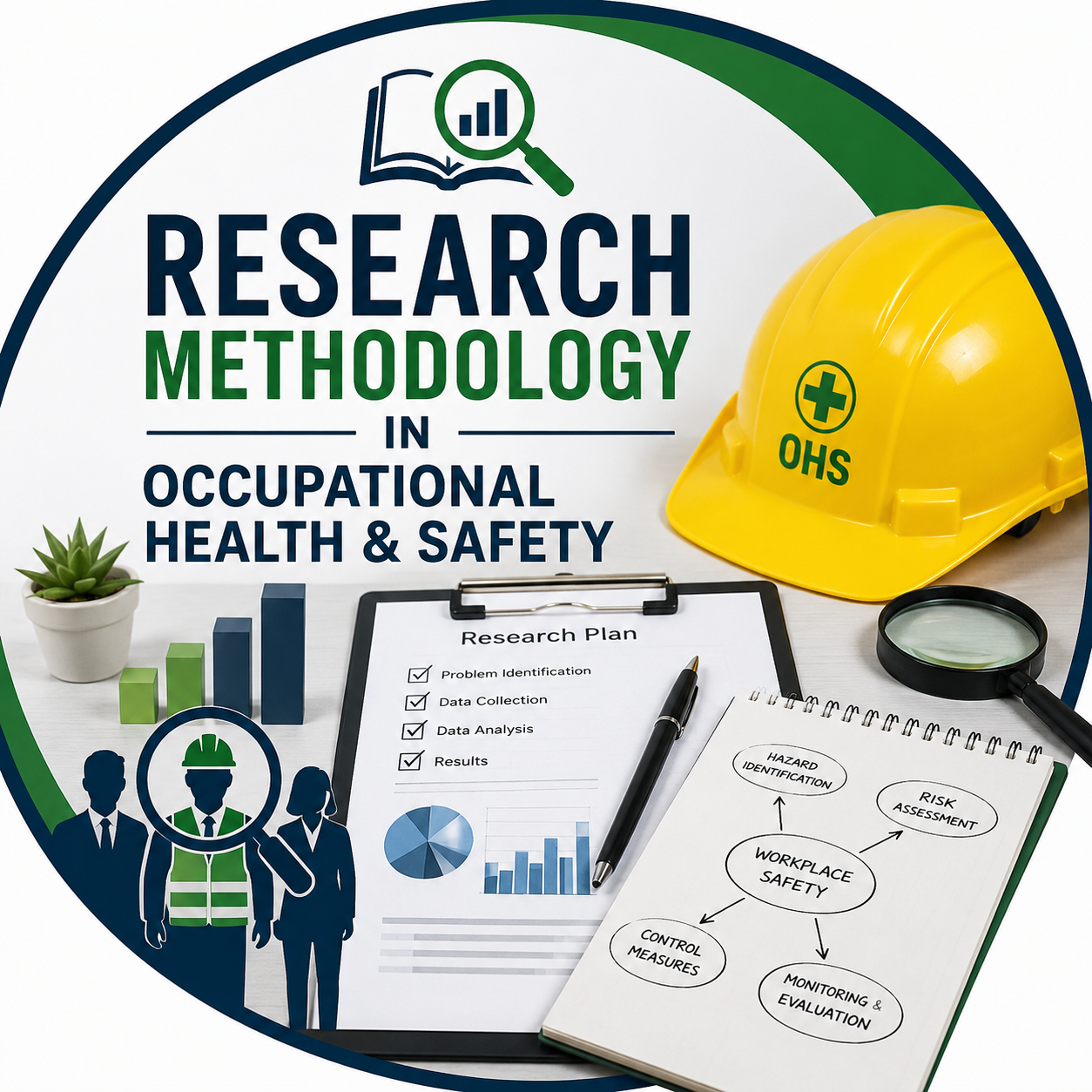 Course Summary: Research Methodology in Occupational Health and Safety
This course introduces learners to basic research principles and their application in Occupational Health and Safety. It covers problem identification, research objectives, literature review, data collection, analysis, ethics, and report writing.
Learners will gain practical skills to conduct OHS-related research, assess workplace hazards, investigate safety issues, and recommend evidence-based solutions for improving workplace health and safety.